
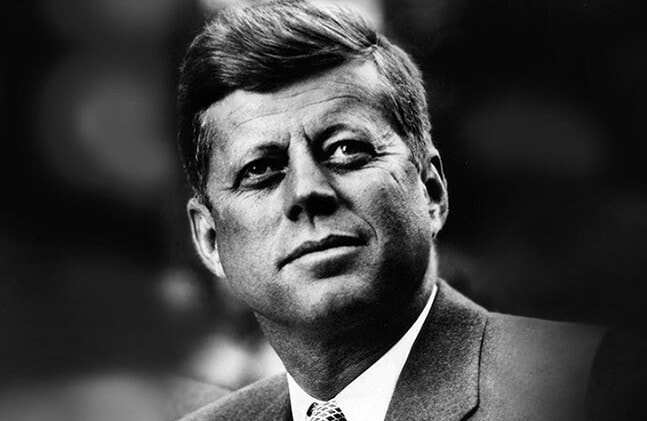
John F. Kennedy, the 35th President of the United States, left an indelible mark on the world not just through his policies but through the power of his words. In a presidency tragically cut short, Kennedy’s eloquence and ability to inspire became a beacon of hope during one of the most tumultuous periods in modern history. From his inaugural address to speeches on civil rights, education, and global peace, his words captured the spirit of an era striving for progress, justice, and innovation.
In this post, we’ll explore 20 of JFK’s most memorable quotes, each a reflection of his vision and leadership. These timeless statements provide a glimpse into the challenges and triumphs of his presidency, as well as the enduring values he championed. Whether calling for courage in the face of adversity or urging humanity to reach for the stars, Kennedy’s words continue to inspire generations to think boldly, act responsibly, and dream ambitiously.
1. “Ask not what your country can do for you – ask what you can do for your country.”
John F. Kennedy delivered this iconic line during his inaugural address in Washington, D.C., on January 20, 1961. The speech marked the start of his presidency and aimed to inspire Americans to embrace civic responsibility. Against the backdrop of Cold War tensions, Kennedy sought to unite the nation by emphasizing the importance of selfless service.
The quote resonated deeply with the American public and became a rallying cry for initiatives like the Peace Corps. Its enduring legacy lies in its ability to motivate generations to contribute to the greater good, making it one of the most memorable lines in U.S. political history.
2. “We choose to go to the Moon in this decade and do the other things, not because they are easy, but because they are hard.”
On September 12, 1962, at Rice University in Houston, Texas, Kennedy captivated the nation with his ambitious vision for space exploration. He framed the moon landing as a test of American resolve and ingenuity, urging the country to rise to the challenge during the height of the Space Race.
This bold statement inspired public confidence and secured support for NASA’s Apollo program. The quote symbolizes America’s can-do spirit and remains a testament to Kennedy’s visionary leadership in science and technology.
3. “Let every nation know, whether it wishes us well or ill, that we shall pay any price, bear any burden, meet any hardship, support any friend, oppose any foe, to assure the survival and the success of liberty.”
Kennedy spoke these stirring words during his inaugural address on January 20, 1961. In the context of the Cold War, he aimed to reassure allies and deter adversaries by affirming America’s unwavering commitment to defending freedom worldwide.
The quote was seen as a powerful declaration of resolve and a cornerstone of Kennedy’s foreign policy. It galvanized a sense of patriotism while cautioning adversaries against underestimating the United States.
4. “Let us never negotiate out of fear. But let us never fear to negotiate.”
This memorable line also came from Kennedy’s inaugural address in 1961. It reflected his balanced approach to diplomacy, advocating for strength and pragmatism in dealing with global conflicts. His message resonated strongly amid Cold War uncertainties.
The quote was widely praised for its wisdom and practicality, embodying Kennedy’s approach during critical moments like the Cuban Missile Crisis. It underscored his ability to combine firmness with diplomacy in international relations.
5. “A man may die, nations may rise and fall, but an idea lives on.”
On October 26, 1963, at the dedication of the Robert Frost Library at Amherst College, Kennedy spoke about the enduring power of ideas. He honored the legacy of poet Robert Frost and highlighted the importance of intellectual freedom and creativity.
The quote gained added poignancy after Kennedy’s assassination just weeks later, serving as a reflection of his commitment to ideals that transcend individual lives. It became a lasting symbol of his belief in the transformative power of ideas.
6. “Children are the world’s most valuable resource and its best hope for the future.”
Kennedy delivered this statement in a special message to Congress on February 14, 1962, addressing the importance of education. He emphasized the need to invest in youth to ensure a prosperous future, aligning with his broader focus on innovation and progress.
The quote resonated with Americans who viewed education as a pathway to opportunity. It remains a timeless reminder of the critical role children play in shaping society’s future.
7. “Efforts and courage are not enough without purpose and direction.”
On June 25, 1963, in a speech at the Paulskirche in Frankfurt, Germany, Kennedy stressed the importance of clear goals and steadfast determination. The context was the Cold War, where leadership and vision were crucial for navigating global tensions.
The statement reinforced the idea that leadership requires more than bold actions; it demands a guiding vision. It resonated with audiences then and continues to inspire those seeking purposeful leadership.
8. “Conformity is the jailer of freedom and the enemy of growth.”
Kennedy shared this insight during Yale University’s commencement ceremony on June 11, 1962. He urged the graduating class to challenge societal norms and embrace individuality as a catalyst for progress.
This forward-thinking perspective resonated during a decade of social change and activism. It remains a powerful call to reject complacency in favor of innovation and critical thinking.
Related Articles
25 Major Events of the 1970s That Defined a Decade
15 Memorable Commercials Boomers Still Quote Today
25 Memorable Movie Quotes Boomers Will Never Forget
9. “If a free society cannot help the many who are poor, it cannot save the few who are rich.”
During his inaugural address in 1961, Kennedy highlighted the moral and practical imperatives of addressing poverty and inequality. He framed economic fairness as essential to the stability of a democratic society.
The quote was widely regarded as a progressive stance on social reform, resonating with advocates for economic justice. It continues to be cited as a reminder of the interconnectedness of freedom and equality.
10. “Forgive your enemies, but never forget their names.”
Kennedy delivered this witty yet profound remark during a dinner honoring Nobel Prize winners on April 29, 1962. The line captured his pragmatic approach to politics, where alliances often intersected with rivalries.
The quote was celebrated for its humor and insight, reflecting Kennedy’s charm and political acumen. It remains a popular expression of the complexities of leadership.
11. “Victory has a hundred fathers, but defeat is an orphan.”
On April 21, 1961, during a press conference following the Bay of Pigs invasion, Kennedy candidly addressed the operation’s failure. Acknowledging the defeat, he referenced this Italian proverb to highlight how success often has many claimants, but failures leave leaders isolated.
The quote showcased Kennedy’s willingness to take responsibility during a difficult moment. While the Bay of Pigs was a low point in his presidency, this remark demonstrated humility and accountability, which softened public criticism and reinforced his credibility as a leader.
12. “Do not pray for easy lives. Pray to be stronger men.”
Kennedy used this powerful statement in a speech to the Massachusetts State Legislature on January 9, 1961, shortly before becoming president. He called on citizens and leaders to embrace challenges with strength and resilience rather than seeking comfort or ease.
The quote resonated as a call to courage and fortitude, aligning with Kennedy’s broader theme of personal responsibility. It continues to inspire those facing adversity to strive for growth rather than retreat.
13. “Mankind must put an end to war, or war will put an end to mankind.”
Kennedy made this sobering declaration during a speech to the United Nations General Assembly on September 25, 1961. Against the backdrop of nuclear tensions, he urged global leaders to prioritize disarmament and peace.
The quote reflected Kennedy’s deep concerns about the potential consequences of unchecked militarization. It struck a chord with audiences worldwide, highlighting the urgent need for diplomacy during a precarious era.
14. “One person can make a difference, and everyone should try.”
This inspiring sentiment was part of Kennedy’s address at the White House on May 24, 1961, during a ceremony recognizing community leaders. He emphasized the power of individual actions to create meaningful change.
The quote resonated as a simple yet profound reminder of the impact each person can have. It became a guiding principle for many initiatives, including the Peace Corps, further solidifying Kennedy’s legacy as a champion of civic engagement.
15. “A nation reveals itself not only by the men it produces but also by the men it honors, the men it remembers.”
On October 26, 1963, Kennedy spoke these words at the dedication of the Robert Frost Library at Amherst College. He used the occasion to reflect on the values a nation upholds through its recognition of leaders, thinkers, and artists.
The statement was perceived as a celebration of intellectual and cultural contributions to society. It remains a poignant reminder of the importance of preserving and honoring a nation’s legacy.
16. “Those who dare to fail miserably can achieve greatly.”
Kennedy delivered this motivational line in a speech at the Convocation of the United Negro College Fund on June 10, 1954. He highlighted the necessity of risk-taking and resilience in the pursuit of significant achievements.
The quote has since become a favorite among leaders and entrepreneurs, embodying the spirit of perseverance. It continues to inspire individuals to embrace challenges and learn from setbacks.
17. “The rights of every man are diminished when the rights of one man are threatened.”
Kennedy expressed this belief in his Civil Rights Address on June 11, 1963. He directly addressed the moral and legal imperatives of ending racial segregation and ensuring equality for all Americans.
The quote was a defining moment in the civil rights movement, demonstrating Kennedy’s commitment to justice. It rallied support for the Civil Rights Act of 1964, solidifying his legacy as an advocate for equality.
18. “Let every citizen, in every country, be prepared to do his part to defend the freedom that is all our duty to preserve.”
Kennedy spoke these words during his State of the Union Address on January 14, 1963. He called for global solidarity and individual responsibility in protecting democratic values during a time of Cold War tension.
This quote emphasized the collective effort required to safeguard liberty. It was well-received as a unifying message that resonated across borders and underscored the importance of shared responsibility.
19. “The goal of education is the advancement of knowledge and the dissemination of truth.”
On February 8, 1962, in a message to Congress about education reform, Kennedy articulated this vision for learning. He emphasized the importance of equipping future generations with the tools to seek truth and drive progress.
The quote was praised for its clarity and vision, highlighting education as a cornerstone of a thriving democracy. It remains a guiding principle for educators and policymakers.
20. “Peace is a daily, a weekly, a monthly process, gradually changing opinions, slowly eroding old barriers, quietly building new structures.”
Kennedy delivered this profound statement during a commencement address at American University on June 10, 1963. He advocated for a long-term commitment to peace, emphasizing the incremental nature of building lasting harmony.
The quote was hailed as one of Kennedy’s most thoughtful reflections on diplomacy. It became a cornerstone of his efforts to de-escalate tensions during the Cold War, particularly with the Soviet Union.
